For a house for rent in Ikeja, the 2026 Ikeja area guide puts a side-street self contain on Allen Avenue at ₦600,000–₦1,000,000 a year and a two-bedroom flat there at ₦2,000,000–₦4,000,000. PropertyPro’s ₦20,000,000 average for a house for rent in Ikeja, and PrivateProperty’s ₦25,000,000 Ikeja GRA average, are pulled up by GRA duplexes rather than the rent a flat-seeker actually faces.
If you are moving back from abroad, or moving across Lagos, the first payment is rarely just the rent: agency fee, agreement fee and caution deposit all fall due at the start, and service charge recurs every year, and the Lagos cost guide cited below puts the first-year outlay at 35–50% above the headline rent. This guide works from dated listing data and published area guides, all checked in November 2026.
Key takeaways
- The 2026 area guide puts side-street self contains on Allen Avenue at ₦600,000–₦1,000,000 a year.
- The same guide puts a 2-bedroom flat on Allen Avenue at ₦2,000,000–₦4,000,000; the figures used here are its Allen Avenue bands.
- PropertyPro’s ₦20,000,000 Ikeja average comes from 592 house listings; Ikeja GRA carries more listings than any other district, and the cheapest verified listing is ₦500,000.
- A December 2024 budget guide puts the ₦150,000 self-contain band on the fringe — Ogba, Agege, Ojodu and the Ketu side — not central Allen Avenue or Ikeja GRA; confirm current availability.
- Budget 35–50% above the rent for agency, agreement, caution and service charge.
Source: PropertyPro Nigeria, 9 November 2026
What a house for rent in Ikeja costs right now
The 2026 Ikeja area guide, published 31 May 2026, puts a 1-bedroom flat on Allen Avenue at ₦1,200,000–₦2,500,000 a year and a 2-bedroom at ₦2,000,000–₦4,000,000. Each band below comes from a named source, with the publication date.
| Flat type | Asking rent (evidence and date) | Source and date |
|---|---|---|
| Self contain | ₦600,000–₦1,000,000 for side-street self contains on Allen Avenue | Ikeja renting guide, 31 May 2026 |
| 1-bedroom flat | ₦1,200,000–₦2,500,000 on Allen Avenue | Ikeja renting guide, 31 May 2026 |
| 2 bedroom flat | ₦2,000,000–₦4,000,000 on Allen Avenue | Ikeja renting guide, 31 May 2026 |
| Lagos-wide 2 bedroom average, not Ikeja (mainland vs island) | ₦2.3M mainland; ₦13.7M island | Lagos Rent Prices 2026, 10 August 2026, updated November 2026 |
| 3-bed block of flats (one listing, not a band) | from ₦15,000,000 in Ikeja GRA | PrivateProperty Ikeja GRA, 9 November 2026 |
| Detached house (one listing, not a band) | an 8-bed duplex with BQ in Ikeja GRA listed at ₦60,000,000 | PrivateProperty Ikeja GRA, 9 November 2026 |
Source: PropertyPro Nigeria and PrivateProperty Nigeria Ikeja listings, 9 November 2026
No source checked for this guide records a verified room self contain band in central Ikeja. The lowest verified house listing on PropertyPro was ₦500,000, and the ₦150,000 section below explains what the December 2024 budget guide supports.
How this table was built
The figures are asking rents from live listings and published area guides, checked between 8 and 10 November 2026. The rent bands and the ranking come from the named listing pages and area guides checked between 8 and 10 November 2026. The draft Lagos Bill is used here only for the fee, receipt and notice rules set out in the later sections. The checked published ranges are asking rents on comparable new listings, not closed deals (Lagos Rent Prices 2026, August 2026, updated November 2026), so treat every number as the landlord’s opening position rather than the price the last tenant paid. The 2026 area guide figures used here are its Allen Avenue bands, not a whole-Ikeja figure.
Why the portal averages mislead
PropertyPro showed 592 houses for rent in Ikeja at an average asking rent of ₦20,000,000, with a range from ₦500,000 to ₦50,000,000. Ikeja GRA alone carried more listings than any other district, and one GRA listing was advertised at ₦60,000,000 on PrivateProperty. Averages built from that stock describe duplexes, not the flat you are hunting.
The portal’s own flat table shows three-bedroom flats as the largest single band, ahead of one-bedroom.
Rent by flat type: from room self contain to three-bedroom flat
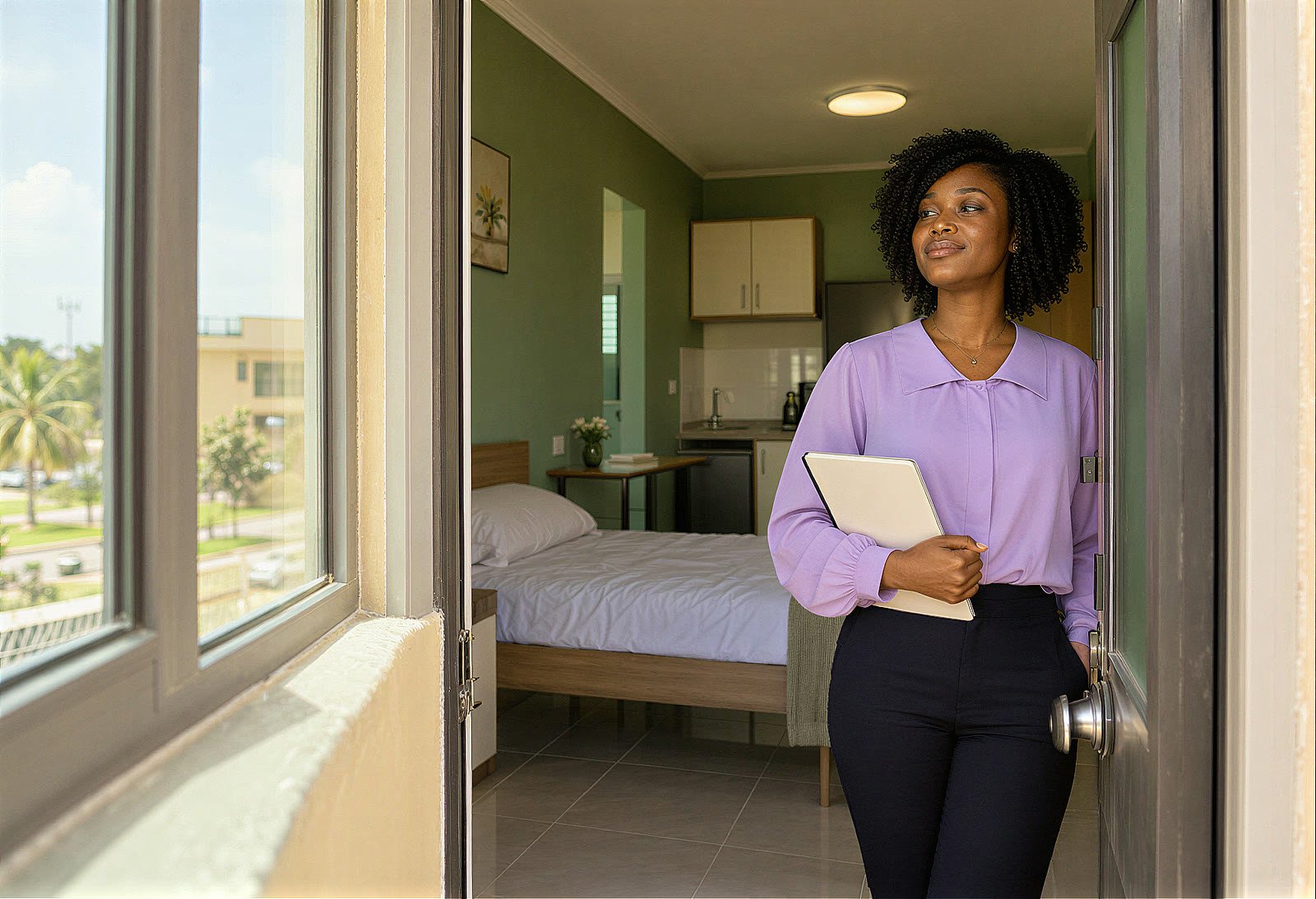
The 2024 budget guide defines a self contain as one private unit behind one door: its own room, toilet and bathroom, a small kitchenette or cooking corner, and nothing shared.
Room self contain
The December 2024 budget guide puts the ₦150,000 self-contain band in Ogba, Agege, Ojodu and the Ketu fringe, not central Allen Avenue or Awolowo Road, with Ikeja GRA self-contains starting above that budget (Apartments.ng, 15 December 2024). The guide describes the figures as indicative and tells readers to confirm the current figure on each listing; they are now two years old.
Self contain and one-bedroom flat
The 2026 area guide puts side-street self contains on Allen Avenue at ₦600,000–₦1,000,000 a year and a 1-bedroom flat at ₦1,200,000–₦2,500,000 (Ikeja renting guide, 31 May 2026).
Two and three bedroom flats
Two-bedroom flats on Allen Avenue ask ₦2,000,000–₦4,000,000 a year, according to the area guide. The GRA median of ₦30.2M is across all property types, not a two-bedroom flat band.
A 3-bed block of flats inside the GRA is listed from ₦15,000,000 (PrivateProperty, 9 November 2026), with a furnished 3-bedroom flat at ₦30,000,000 and a 3-bedroom apartment with BQ at ₦35,000,000 (PropertyPro, 9 November 2026).
What the rent does not include
Rent in Lagos expressly excludes charges for services and facilities under the draft Lagos tenancy Bill. In practice that means service charge (from about ₦50,000 a year in a small compound to several million in premium towers); ask whether power is metered separately. Outside estates you also supply backup power: diesel runs ₦20,000–₦60,000 a month depending on grid hours, drinking water ₦2,000–₦4,000 per 18.9-litre bottle, and fibre internet ₦15,000–₦30,000 a month (Ikeja renting guide, 31 May 2026).
On furniture, the listings show a spread: a furnished 3-bedroom flat in the GRA at ₦30,000,000 against a 3-bedroom block of flats from ₦15,000,000.
Ikeja area by area: GRA, Allen, Opebi, Oregun and the rest
Ikeja is three markets wearing one name: the commercial core, the GRA, and a residential ring of family estates.
Ikeja GRA
The GRA is the premium, low-density pocket, with tree-lined streets such as Joel Ogunnaike, Isaac John, Oba Akinjobi and Sobo Arobiodu. PrivateProperty put the GRA median at ₦30.2M a year in October 2026 across 72 properties of all types, with a ₦9,000,000 floor and a stated top of ₦50,000,000. Self contains and shared flats inside the GRA are scarce and move fast. The undated company guide The True Cost of Renting in Nigeria: Agency Fee, Agreement Fee & Caution Deposit Explained, checked in November 2026, states that Ikeja GRA is exempt from the Lagos State Tenancy Law — a claim not confirmed by LASRERA or the law text — which would affect the fee caps and advance-rent rules below, so confirm the position with a lawyer before you rely on it.
Allen Avenue and Opebi
Allen Avenue is the commercial and nightlife spine, so you are paying for centrality, not quiet: generator noise, traffic and weekend nightlife come with the address. The 2026 area guide gives ₦1.2M–₦2.5M for a 1-bedroom, ₦2M–₦4M for a 2-bedroom and ₦600,000–₦1,000,000 for side-street self contains. A 4-bedroom flat on Allen Avenue was listed at ₦5,500,000 a year, and a 3-bedroom duplex there at ₦15,000,000, while an Opebi 4-bedroom semi-detached duplex asked ₦12,000,000 (PropertyPro, 9 November 2026).
Oregun, Agidingbi and Akiode
Oregun sits east of the core, close to the industrial estate and the Lagos–Ibadan Expressway, and runs a little cheaper than Allen or Opebi for similar property. A 3-bedroom semi-detached duplex with BQ there asks ₦18,000,000 a year (PropertyPro, 9 November 2026). Agidingbi is quieter and near Ikeja City Mall, and a 6-bedroom terraced duplex in Omole Phase 1 Estate asked ₦14,500,000–₦15,000,000 (PropertyPro, 9 November 2026). The 2024 budget guide notes that Agidingbi and Oregun back streets are tidier but the cheap units move fast.
Ogba, Maryland and the Ojodu fringe
These are residential areas in the Ikeja ring. The 2026 area guide describes Ogba as one of the more affordable parts of the ring, denser and less polished than Magodo or Omole, and Maryland as a middle-class neighbourhood with links to the Ikeja core and the Third Mainland Bridge route. For a benchmark rather than an Ogba-specific quote, Lagos Rent Prices 2026 gives a mainland 2-bedroom average of ₦2.3M a year across 11 areas, against ₦13.7M across seven island areas (10 August 2026, updated November 2026), and its footer gives a mainland average of about 15% year-on-year rent growth across the 18 areas it tracks. A newly built 4-bedroom detached duplex in Maryland asks ₦38,000,000 a year (PropertyPro, 8 November 2026).
Ojodu Berger is a busy transit hub with strong onward links to Ibadan and Abeokuta. The Red Line rail now runs the Agbado–Ikeja–Yaba corridor to Marina, which changes the commute maths for the whole ring.
For scale, PropertyPro’s ₦20,000,000 Ikeja house average sits far above the ₦2,000,000–₦4,000,000 Allen Avenue two-bedroom band, because the portal average is pulled up by duplexes.
Ipodo, Anifowoshe and Agege Motor Road
Ask for current quotes street by street for Ipodo and Anifowoshe rather than a district-level figure. What the December 2024 budget guide does support is the ₦150,000 self-contain band on the fringe: Ogba, Agege, Ojodu and the Ketu fringe (Apartments.ng, 15 December 2024), not central Allen Avenue or Awolowo Road. Treat that as a two-year-old indicative band, not a quote, and confirm the current figure on the listing. At this end of the market the unit may sit in a shared compound: count how many tenants share it, ask whether the toilet and bathroom are inside your own door, and walk the road after dark as well as in daylight.
Security, water and power
Grid power in GRA, Alausa and the commercial core runs roughly 10–16 hours a day in good stretches, not 24. Most buildings run on a borehole because municipal water is unreliable, so test the supply and the tank during inspection. Ask who pays diesel, whether power is prepaid, and confirm fibre coverage at the specific building before signing.
What ₦150,000 a year actually gets you in Ikeja
The December 2024 budget guide puts a ₦150,000 self-contain on the fringe — Ogba, Agege, Ojodu and the Ketu side — and says it is achievable off the prime stretches, but the unit may sit in a shared compound. No source checked for this guide confirms a ₦150,000 Ikeja listing today, and the lowest verified house listing on PropertyPro was ₦500,000; treat the 2024 band as indicative and confirm current availability on the listing.
If your budget is fixed at ₦150,000
Start from what the 2024 guide supports: a self-contain on the fringe, possibly in a shared compound. Confirm the toilet and bathroom are inside your own door rather than shared, count how many people share the compound, and check the road after dark. The guide calls Ogba and Agege the most reliable budget areas, with Agidingbi and Oregun back streets tidier but faster-moving.
Fee red flags on a ₦150,000 rental
Watch the fee risks. The rent is only one part of the move-in cost: agency, agreement and caution add to it, so ask for the full breakdown in writing. A cash inspection or reservation fee demanded before viewing is a red flag; a viewing fee is a scam signal, not a normal cost.
Do the arithmetic before you travel. On a ₦150,000 rent, 10% agency (₦15,000), 10% agreement (₦15,000) and a 10% caution deposit (₦15,000) take the first payment to ₦195,000. The wider rule of thumb for Lagos is to budget 35–50% on top of the headline rent, which puts a ₦150,000 unit at ₦202,500–₦225,000. Under the draft Bill’s proposed 5% agency cap, the agency fee would be ₦7,500 instead.
Negotiate the fees, not just the rent: the source on Lagos fees says agreement fees and service charges move more than the rent, especially on long-vacant units or outside peak season.
The full move-in cost, not just the rent

Rent is usually one or two years upfront, and everything else stacks on top. These percentages are convention from a company cost guide, not law, and they were checked in November 2026.
| Fee | Usual basis | Notes |
|---|---|---|
| Rent | 1 year (sometimes 2) upfront | The draft Bill would bar more than one year from a new tenant; the GRA exemption claim above would affect this — confirm with a lawyer |
| Agency fee | 10% of annual rent | Lagos’s housing adviser has said fees must be 0–10%; the draft Bill proposes 5%; the GRA exemption claim above would affect this — confirm with a lawyer |
| Legal / agreement fee | 10% of annual rent | Covers preparing the tenancy agreement |
| Caution deposit | 10–25% of annual rent, refundable | Document defects room by room at move-in |
| Service charge | ₦50,000 a year to several million | Separate from rent; demand a receipt and a six-monthly account |
| Stamp duty | 0.78% for a 0–7 year lease, or ₦500 flat for an ordinary agreement | Plus ₦50 per extra copy |
The worked example in the same guide: a ₦1,500,000-a-year flat with 10% agency, 10% agreement, 10% caution and ₦200,000 service charge costs ₦2,150,000 to move into — 43% above the rent.
- 0 – 7 years0.78% ad valorem
- Above 21 years6%
- Ordinary or open agreement₦500 flat, plus ₦50 per extra copy
Source: Stamp Duty Made Easy (Federal Inland Revenue Service), 2018 (© notice on page)
The FIRS table carries a 2018 copyright notice. Check the current rate with the Lagos Internal Revenue Service before you rely on it.
Fees you should see in writing
Ask for one written breakdown before you inspect: rent, agency, agreement, caution, service charge, waste and security. Require a receipt that names both parties, the unit, the amount and the period covered — the draft Bill makes that receipt mandatory and requires the service charge to be receipted separately with a written account at least every six months.
Fees you should refuse
- A cash inspection fee with no receipt, or any viewing fee at all.
- Two agency fees because two agents chained themselves to one landlord.
- An agency fee at renewal: the company cost guide cited above describes agency fee as a one-time charge, so query an agency fee at renewal and check the tenancy agreement.
- An undocumented fee that appears after you have committed.
- Any payment to a personal account when you were told to pay a business.
Before you pay: documents and checks for a rental in Ikeja
The tenancy agreement is the document that matters most to a renter, and the landlord’s title documents are a check on whether the person letting the unit has the right to let it.
The tenancy agreement
It should name the landlord, the address and unit, the rent, the term, the service charge, the caution deposit and its refund terms, the notice period and who handles repairs. If the agreement is silent on notice, the draft Bill’s default is six months for a yearly tenant and one month for a monthly tenant. Service charge, facility and security deposits must be written in, not quoted verbally afterwards.
The landlord’s title documents
You are checking the landlord’s right to let, not buying the title, but a landlord who can show nothing is a risk. Ask to see:
- A survey plan — the boundary drawing of the land; ask the landlord or a lawyer to confirm it matches the address and the unit you are renting.
- A deed of assignment — the document that transferred the property to the current owner; ask a lawyer to confirm the ownership history it records.
- A Certificate of Occupancy (C of O) — the state’s grant of a long lease over the land — and governor’s consent, the state’s approval of a title transfer, which The African Vestor (early 2026) describes as required for most statutory land transfers in Nigeria. The same source calls title search and governor’s consent verification the checks that must never be skipped in Lagos, because ownership histories are often incomplete or disputed.
Verifying the agent
Check the agent’s registration on the official LASRERA register (lasrera.lagosstate.gov.ng); if it is down, use the Lagos State portal as a fallback. The LASRERA site was not loading when one source checked it in October 2026, so allow time. Registration does not prove the agent owns the property or has authority to market it. Pay to a business account, never a personal one, and preserve the agent’s profile, the payment request and the payment evidence before you report a problem.
- Water source and tank working Test on site
- Meter type (prepaid or shared) Confirm in writing
- Service charge and last year’s figure Ask for receipt
- Demolition, road setback or high-tension cables Ask and look up
- Rainy-season flooding on the street Ask neighbours
- Receipt naming landlord, unit, amount, period Collect
- Signed copy of the tenancy agreement Keep
Lagos’s September 2026 flood alert named Island and waterfront districts, with no Ikeja district listed, so ask about the specific street rather than the whole area. On the building itself, ask whether it holds LASBCA’s certificate of completion and fitness for habitation, since LASBCA removes non-conforming structures across the state.
Renting from abroad: how to inspect and pay without being defrauded
A live video call beats any set of photographs, and the sequence of payment matters more than the price you agree.
- Send the agent the map pin and ask them to start the call at the street gate, not inside the flat.
- Ask them to walk, without cutting the call, from the gate to the unit door and show the house number on the wall.
- Ask them to pan to one landmark you can find on a map, such as the estate gate, a mosque, a filling station or a named junction.
- Ask them to open the tap, flush the toilet and show the meter reading while still on the call.
- Ask for a recent utility bill or the estate levy receipt for that exact address.
- Send the recorded call and the address to the lawyer or relative who will hold your documents.
Then pay in the right order: signed agreement first, payment second, to a named business or landlord account, with the documents going to your lawyer or a trusted relative. If you can, book a one- to three-month shortlet in Ikeja first. GRA and Allen Avenue are the hubs for monthly serviced apartments.
Payment red flags: pressure to pay in full before the unit is confirmed genuine.
Furnished shortlets versus annual rent in Ikeja
A shortlet and an annual rent are quoted on different bases, so compare like with like: a shortlet costs more than one twelfth of an annual rent, according to apartments.ng (20 October 2026), because the premium pays for furniture, bills, cleaning and convenience. A serviced shortlet bundles furniture, linen, kitchen equipment, power infrastructure and management support (Ghecs, May 2026).
PropertyPro’s Ikeja shortlet page showed 729 shortlets on 8 November 2026, with stock concentrated in Ikeja GRA, Opebi and Allen Avenue. The portal states an average shortlet price of ₦160,000 but does not say whether that is per day, per listing or per stay, so this guide does not turn it into a nightly rate. Ask a specific provider for the monthly rate and compare that with one-twelfth of the annual rent. A ₦2,000,000–₦4,000,000 annual two-bedroom on Allen Avenue divides to roughly ₦167,000–₦333,000 a month, before service charge, diesel, water and internet. Monthly shortlet rates are usually discounted against daily rates for stays of 30 days or more (Africonomy, checked November 2026), so ask for the monthly rate rather than paying the nightly rate for a full month. A shortlet also carries no agent commission or caution fee, because it is a hospitality booking, not a tenancy, usually with a 30-day minimum.
Source: PropertyPro Nigeria — shortlets in Ikeja, 8 November 2026
A shortlet wins for your first month after landing, for a contract under six months, or while you inspect areas before committing. Annual rent wins for anything past six months, especially when you can pay a year upfront and negotiate. Demand the full cost breakdown before booking: cleaning fees, capped electricity and amenity surcharges hide in shortlet adverts.
What this means for you
At the flat level, Ikeja is priced by area and by how close you are to the commercial core; at the duplex level, the portal averages cited here are a different market. Decide the area first — the GRA is the premium pocket, Oregun is a little cheaper than Allen or Opebi for similar property, Agidingbi is quieter, and Ogba and Agege are among the more affordable parts of the ring — then match the flat type to the money you actually have on the day, including the 35–50% on top. If your budget is ₦150,000, start with the 2024 fringe band, inspect in daylight, and refuse any fee you cannot get a receipt for.
One next step: before you pay any agent, inspection or agency fee in Ikeja, check the agent’s LASRERA registration and insist the full fee breakdown goes into the written tenancy agreement — and read how the prices in this guide are sourced and dated so you know where each figure came from. For the wider Lagos picture, see apartments for rent in Lagos and houses for rent in Lagos on the Nigeria Homes home page.
Sources
- PropertyPro — 592 Houses for Rent in Ikeja, Lagos, 9 November 2026
- PrivateProperty — property for rent in Ikeja GRA, 9 November 2026
- Hutbay property listings
- The Complete Guide to Renting in Ikeja (2026), 31 May 2026
- Lagos Rent Prices 2026: Neighborhood Comparison, 10 August 2026, updated November 2026
- Self-Contain for ₦150k in Ikeja: Cheap Rooms Guide, 15 December 2024
- The True Cost of Renting in Nigeria: Agency Fee, Agreement Fee & Caution Deposit Explained
- Lagos State Tenancy and Recovery of Premises Bill — 2025 (Draft)
- Stamp Duty Made Easy, Federal Inland Revenue Service, 2018
- Lagos Internal Revenue Service — tax types
- LASRERA Registration: What Lagos Buyers Should Know, 7 October 2026
- Lagos State Ministry of the Environment — flood alert, 21 September 2026
- LASBCA
- Property Taxes, Fees and Costs in Lagos (2026), early 2026
- Monthly Short Let Apartments in Lagos Guide 2026, 8 May 2026
- PropertyPro — shortlets in Ikeja, 8 November 2026
- Monthly Shortlet Apartments in Ikeja: What You Should Expect
- Shortlet Apartment in Ikeja: Prices & Live Listings, 20 October 2026
Frequently asked questions
How much is rent for a house in Ikeja right now?
On Allen Avenue, the 2026 area guide, published 31 May 2026, puts a side-street self contain at ₦600,000–₦1,000,000 a year, a 1-bedroom flat at ₦1,200,000–₦2,500,000 and a 2-bedroom flat at ₦2,000,000–₦4,000,000. The GRA figure available here is a median across all property types, not a flat-type band: PrivateProperty puts the GRA median at ₦30.2M a year in October 2026 and lists a 3-bedroom block of flats from ₦15,000,000.
Is ₦150,000 enough for a room self contain in Ikeja?
A December 2024 budget guide puts the ₦150,000 self-contain band on the fringe — Ogba, Agege, Ojodu and the Ketu side — not central Allen Avenue, and says to confirm the current figure on the actual listing. No source checked for this guide confirms a ₦150,000 Ikeja listing today, and the cheapest verified house listing on PropertyPro was ₦500,000. Inspect in daylight and check whether the toilet and bathroom are inside your own door.
What is a self contain?
A self contain is one private unit behind one door: its own room, toilet and bathroom, a small kitchenette or cooking corner, and nothing shared (Apartments.ng, December 2024).
Do I have to pay two years’ rent upfront in Ikeja?
Most Nigerian landlords ask one year upfront and some ask two, according to a company cost guide. A 2025 draft Lagos tenancy Bill would bar a landlord from asking a new tenant for more than one year, but it is a Bill, so check whether it has been enacted before you rely on it.
What documents should I check before paying rent in Lagos?
Read the tenancy agreement for the rent, term, service charge, caution deposit and refund terms, and notice period. Ask a lawyer to check the landlord’s title documents, including the survey plan, deed of assignment, C of O and governor’s consent; a tenancy does not give you the landlord’s title. Check the agent’s LASRERA registration on the official Lagos State domain, and pay only to a business account with a receipt naming both parties, the unit, the amount and the period.