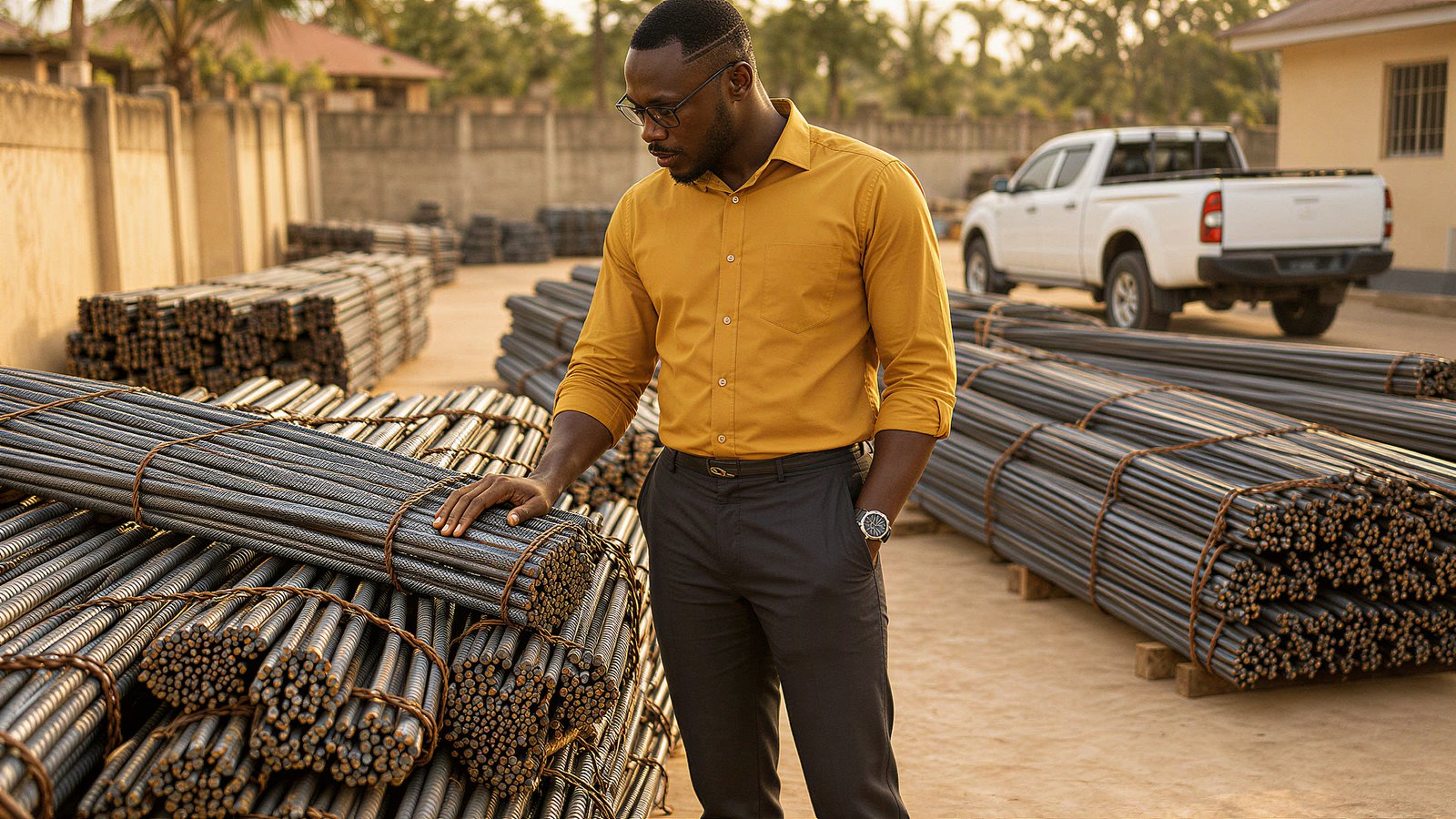
The latest published ranges, read on 10 November 2026, put the price of 12mm iron rod in Nigeria at ₦8,500 to ₦11,700 for one 12-metre length and ₦700,000 to ₦760,000 for one tonne. Neither is a national list price; prices move with demand, exchange rates and supply conditions. If you are pricing a slab in Lagos or Abuja, or sending money from abroad, the per-piece figure alone will not tell you whether a dealer’s quote is fair — the per-tonne and per-kilogram conversions below will, and the Nigeria Homes homepage carries the rest of the building-cost tables.
Key takeaways
- One 12m 12mm rod: ₦8,500–₦11,700 retail per piece; a narrower national average range of ₦8,500–₦9,800 (both checked 10 November 2026).
- One tonne of 12mm rods: ₦700,000–₦760,000, below the all-size headline range of ₦800,000–₦1.1 million per tonne.
- A tonne holds about 94 theoretical 12m 12mm rods, because 12mm weighs 0.889 kg per metre and 10.67 kg per 12m bar.
- TMT rod usually costs ₦50,000–₦100,000 more per tonne than local rod, and delivery is usually extra.
- Counting rods per tonne exposes short-weight deliveries: far more than 94 rods in a "tonne" of 12mm means thinner bars.
Source: Iron Rod Price in Nigeria 2026, NaijaSabi, 12 October 2026
Price of 12mm Iron Rod in Nigeria Today: The Short Answer
There is no single national price for a 12mm rod, and any page that gives you one number without a date is guessing. Both Nigerian sources used here were read on 10 November 2026. NaijaSabi is dated 12 October 2026 and puts one 12-metre 12mm rod at ₦8,500 to ₦11,700 retail; Prioni lists ₦8,500 to ₦9,800 per 12-metre rod and, separately, ₦700,000 to ₦760,000 per tonne. The Prioni page itself shows no publication or price-check date, so 10 November 2026 is when that page was read, not when its prices were set.
What one 12m 12mm rod costs
At retail, a single 12mm reinforcement rod is quoted at ₦8,500 to ₦11,700 per 12m length for TMT or local steel (NaijaSabi, checked 10 November 2026). A second tracker puts the national average range slightly tighter at ₦8,500 to ₦9,800 per 12m rod (Prioni, checked 10 November 2026). Abuja TMT sellers quote higher, at ₦9,000 to ₦13,500 per rod (TopNaijaBiz, checked 10 November 2026), and one online marketplace listing shows ₦12,980 per piece with no bar length stated and delivery only quoted at checkout.
What a tonne of 12mm rods costs
By weight, 12mm rod is listed at ₦700,000 to ₦760,000 per tonne (Prioni, checked 10 November 2026). That sits below the headline all-size range of ₦800,000 to ₦1.1 million per tonne for local and TMT rods (NaijaSabi, checked 10 November 2026), and below the bulk rates of ₦800,000–₦900,000 per tonne for local and ₦900,000–₦1,000,000 per tonne for TMT in trailer-load quantities from the same source.
The gap between those two per-tonne figures is the lesson. A per-tonne price is only comparable when the quote names the size, the type, the brand, the quantity and whether delivery and VAT are inside it. Ask which of those the number covers before you treat it as cheaper.
Why you will see different prices
Seven things explain a difference between two rod quotes: TMT versus local, the brand, the quantity, the city, the date, whether VAT is included, and whether delivery is included. One Lagos supplier’s page lists iron rods (all sizes, TMT and mild steel) at ₦920,000 to ₦1,400,000 without saying whether that range is per tonne or per length (checked 10 November 2026) — a figure you cannot compare with anything until the basis is stated.
Some published ranges sit well below the other quotes here. A general steel price page checked on the same day still shows ₦250,000 to ₦600,000 per tonne for steel bars with no size or grade named, far below every other per-tonne quote here. Treat that kind of page as a warning about undated prices, not as a bargain.
The per-kilogram check
Divide a per-tonne quote by 1,000 and you have a per-kilogram price: ₦700,000 a tonne is ₦700/kg, and ₦760,000 a tonne is ₦760/kg. A theoretical 12mm bar of 10.67 kg therefore works out at roughly ₦7,469 to ₦8,109 per length. A retail piece at ₦9,500 is about ₦890/kg; at ₦11,700 it is about ₦1,097/kg. That gap is the retail premium a per-piece buyer pays over the per-tonne rate.
Dated Iron Rod Price Table by Size: 10mm, 12mm and 16mm
Every row below carries its own source and a date. For NaijaSabi that is the source’s own publication date; for Prioni, 10 November 2026 is the date the page was read, because the page itself shows no price-check date. Blending prices from different months into one "today" column is how bad tables mislead buyers.
| Size | Weight per 12m bar (theoretical) | Rods per tonne (theoretical) | Per 12m rod, NaijaSabi (published 12 Oct 2026; checked 10 Nov 2026) | Per 12m rod, Prioni (10 Nov 2026) | Per tonne, Prioni (10 Nov 2026) |
|---|---|---|---|---|---|
| 8mm | 4.74 kg | 211 | ₦3,800 – ₦5,200 | ₦4,800 – ₦5,500 | Not published |
| 10mm | 7.41 kg | 135 | ₦5,900 – ₦8,100 | ₦6,000 – ₦7,200 | ₦710,000 – ₦770,000 |
| 12mm | 10.67 kg | 94 | ₦8,500 – ₦11,700 | ₦8,500 – ₦9,800 | ₦700,000 – ₦760,000 |
| 16mm | 18.96 kg | 53 | ₦15,200 – ₦20,900 | ₦15,000 – ₦17,500 | ₦690,000 – ₦750,000 |
| 20mm | 29.63 kg | 34 | ₦23,700 – ₦32,600 | ₦23,000 – ₦26,000 | Not published |
| 25mm | 46.30 kg | 22 | ₦37,000 – ₦50,900 | ₦36,000 – ₦42,000 | Not published |
| 32mm | 75.85 kg | 13 | ₦60,700 – ₦83,400 | Not published | Not published |
Ask every dealer whether VAT and delivery are inside the figure before you compare it with another quote. The date attached to each figure matters as much as the number; contact Nigeria Homes if a dealer will not put a date on a quote.
How to read the table
Per-tonne prices barely differ across bar sizes, because rods are sold mainly by weight (NaijaSabi). Per-piece prices climb steeply with size, because each bar carries more steel: a 16mm rod holds nearly twice the steel of a 12mm rod at the same 12m length. That is why a "cheap" 12mm per-piece quote and an expensive 16mm per-piece quote can both be fair.
Lagos, Abuja and South-East price notes
| Market | Iron rods per tonne (Prioni, 10 Nov 2026) | 12mm per 12m rod (Prioni, 10 Nov 2026) |
|---|---|---|
| Lagos | ₦690,000 – ₦740,000 | ₦8,500 – ₦9,500 |
| Abuja | ₦720,000 – ₦770,000 | ₦9,000 – ₦10,000 |
| Enugu | ₦715,000 – ₦765,000 | ₦8,900 – ₦9,900 |
| Port Harcourt | ₦710,000 – ₦760,000 | Not published |
Lagos is quoted cheapest, and the stated reason is port proximity and a concentration of steel distributors rather than better quality (Prioni). Enugu is separately described as one of the cheaper markets, with 12mm at about ₦8,500 a length (NaijaSabi). Abuja buyers are pointed to Dei-Dei International Building Materials Market, and the New Bakasi iron and steel market in Jabi is given as a multi-dealer yard where several TMT sellers sit together, so per-tonne comparison can be done in one visit (TopNaijaBiz).
What the quote must state
- The bar size, in millimetres, and whether it is TMT or local/mild steel.
- The brand and the mill, where the dealer will name one.
- The length of each bar, in metres — confirm 12m before converting anything.
- The quantity, in pieces and in tonnes, and whether it is a full bundle.
- The unit price and whether VAT is included.
- The delivery charge, the delivery address and the delivery date.
How Many 12mm Rods Are in a Tonne? The Arithmetic

About 94 twelve-metre 12mm rods make one tonne. The working: the standard steel weight formula is diameter squared divided by 162, which gives kilograms per metre (NaijaSabi). For 12mm: 12 × 12 ÷ 162 = 0.889 kg per metre. Multiply by a 12m length and one bar weighs about 10.67 kg, so a 1,000 kg tonne holds about 94 rods. The same formula gives roughly 135 rods of 10mm and 53 rods of 16mm to the tonne.
Source: Iron Rod Price in Nigeria 2026, NaijaSabi, 12 October 2026
The standard length of a 12mm rod in Nigeria
The standard Nigerian reinforcement rod is 12 metres long, and reinforcement is quantified by weight but supplied in 12m lengths (NaijaSabi; Structville). Confirm the length on the quote anyway, because the weight and the per-piece price both depend on it; one online marketplace listing checked for this study states no bar length at all.
Per-length to per-tonne conversion
Say a dealer quotes 100 pieces of 12mm at ₦8,500 each. That is ₦850,000 for the batch. By weight, 100 × 10.67 kg = 1,067 kg, or about 1.07 tonnes, so the effective per-tonne price is about ₦797,000. At ₦9,500 a piece the same batch costs ₦950,000, or about ₦890,000 per tonne. Both are above the ₦700,000–₦760,000 per-tonne listings, which is the normal retail premium for buying in pieces rather than tonnes.
Why the count is not always exactly 94
Bundle counts and weighbridge readings can differ from the theory. One Lagos seller advertises 10mm rod at 133 pieces to the tonne rather than stating a weight (Jiji, checked 10 November 2026). Even the price trackers contradict themselves: Prioni’s table gives 12mm at 90–100 pieces per tonne while its own FAQ says 94–98, and its table gives 10mm at 130–140 while the FAQ says 150–160. Use the arithmetic, then ask to see the scale ticket.
Too many rods in a ‘tonne’ of 12mm
If a bundle sold as one tonne of 12mm contains noticeably more than about 94 rods, the bars are likely undersized. A bar sold as 12mm that measures 10–11mm across the core is the classic short-weight delivery (NaijaSabi).
How Much Steel Does a Typical House Need?
It cannot be read off the floor area. The steel quantity comes from the structural drawings and the bar bending schedule, and any rule-of-thumb tonnage must be confirmed by a structural engineer before it is used to budget (Structville).
What changes the tonnage
Each element of a building uses different bar sizes and spacing. Strip foundations for a bungalow are commonly reinforced with 12mm rods, bungalow columns commonly use 12mm while duplexes and above use 16mm, and suspended slabs commonly use 10mm or 12mm at the engineer’s spacing (NaijaSabi). A moderate-span duplex beam takes 7.9–9.5 kg of Y16 per linear metre plus 2.5 kg per linear metre of Y8 links, and a lintel takes 3.55 kg of Y12 per linear metre (Structville). Those are the figures that make up a real schedule.
A worked budget illustration, clearly labelled
This is an illustration from a published estimating guide, not a real property, project quote or guarantee. For a moderately spanned 250 m² duplex floor slab, the guide assumes 12.5 kg of Y12 bottom steel per square metre, top steel at 25% of the bottom weight, and distribution bars at 12% of the bottom weight in Y10 (Structville):
| Bar type in the 250 m² slab example | Tonnes |
|---|---|
| Y12 bottom reinforcement | 3.125 |
| Y12 top (hogging) reinforcement | 0.781 |
| Y10 distribution bars | 0.375 |
| Total | 4.281 |
Priced at the per-tonne ranges above (checked 10 November 2026), the 3.906 tonnes of 12mm comes to roughly ₦2.73 million to ₦2.97 million, and the 0.375 tonnes of 10mm to roughly ₦266,000 to ₦289,000 — about ₦3.0 million to ₦3.26 million for the steel alone, before waste, delivery and VAT. At about 12 kg of binding wire per tonne of reinforcement (Structville), the slab also needs roughly 51 kg of wire.
Then add the allowance. The engineer’s schedule excludes offcuts and wastage, so the order must carry an allowance on top — commonly 5–10% for cutting waste and laps (Structville; NaijaSabi). This is where a budget quietly fails: a 10% allowance on 4.281 tonnes is another 0.43 tonnes.
Where to get the real figure
Ask your structural engineer for a bar bending schedule by bar size and total metres, then convert to rods by dividing by 12 and to tonnes by weight (NaijaSabi). Published rough guides — 3 to 5 tonnes for a three-bedroom bungalow, 6 to 10 tonnes for a four-bedroom duplex (NaijaSabi) — are labelled rough guides by the source and are no substitute for a schedule.
TMT vs Local Rods: What the 12mm Price Is Buying

TMT is thermo-mechanically treated steel: quenched on the outside, softer and more ductile inside, so it bends without cracking better than local rod (NaijaSabi). Local or conventional rods are hot-rolled, often from imported billets or scrap, and vary more from mill to mill. The two are not the same product, so decide which you are buying before you compare prices.
What the label should say
Genuine rods carry the maker’s mark and the size rolled into the bar, so you can read what you are buying rather than take a dealer’s word (NaijaSabi). Deformed bars have surface ridges that grip concrete, while plain mild steel bars are smooth and bond poorly — which is why deformed bars are recommended for houses and standard buildings (Titanium Building Solutions).
What the price gap reflects
TMT commonly costs ₦50,000 to ₦100,000 more per tonne than local rod (NaijaSabi), and largely imported TMT is not as widely stocked in Nigeria as ordinary deformed bar. That premium buys controlled quenching, better ductility and weldability. Whether it is required on your site is a question for the structural engineer, not the dealer.
How to Check a 12mm Rod Before You Pay
Price is only half the transaction; the other half is whether the rod is the size and weight you paid for. Good suppliers allow the rods to be inspected before purchase (TopNaijaBiz).
At the yard
- Bar length measures a full 12m Measure
- Core diameter reads 12mm on a caliper, not across the ribs Verify
- Surface ridges present that grip concrete Inspect
- Maker’s mark and bar size rolled into the steel Verify
- Bundle weight close to 10.67 kg multiplied by the rod count Weigh
- Rust light orange on the surface, not flaking or pitted Inspect
- Price in line with two other suppliers Compare
Light orange surface rust is normal, but flaking or pitted rust means reduced steel (NaijaSabi). Rods priced far below every other supplier are a warning sign, not a bargain, and good suppliers let you inspect before purchase and check for rust or bending before you accept delivery (TopNaijaBiz).
Documents and traceability
Ask for a written receipt stating size, type, brand and quantity, so you have a written record if the rods turn out to be substandard (NaijaSabi). For a locally manufactured rod, ask for MANCAP certification and verify it on SON’s e-MANCAP platform rather than accepting a verbal claim; for an imported rod, the relevant scheme is SONCAP, which covers pre-shipment conformity for regulated imports (Standards Organisation of Nigeria). Note that the NIS Mark of Quality is a voluntary scheme, so a missing mark is not by itself illegal — but SON’s Product Authentication Mark exists so buyers can verify genuineness before purchase, and SON’s head office for a complaint is 52, Lome Crescent, Zone 7, Wuse, Abuja.
If you are buying from the UK or diaspora
Do not transfer money to a dealer you have not verified. Appoint a trusted local representative, ask for a video that shows the measurement and the weighing of the bundle, and pay against documents rather than on a phone call. Ask for the invoice, the delivery note and the dealer’s business details in one email before any transfer. A Lagos supplier’s stated terms give you a benchmark to test others against: a minimum order of one tonne with bulk pricing above it, and same-day or next-day delivery to Lekki, Ikeja, Ajah and Yaba (Titanium Building Solutions).
Why Iron Rod Prices Move in Nigeria
Rod prices follow the cost of making and moving steel: imported billets, the naira exchange rate, fuel and diesel, electricity and haulage. Demand, supply conditions, government policies and tariffs are also listed among the drivers (Legit Technology; NaijaSabi). None of this supports a forecast, and this study makes none.
Cost drivers, with sources
The naira matters because billets and finished steel are imported. Any exchange-rate figure you use should be labelled as the CBN NFEM rate, which the Central Bank itself calls the official rate for the day (CBN); the rate table supplied for this study carried no values, so no rate is quoted here. On energy, the National Bureau of Statistics homepage displayed diesel at ₦3,277.47 and petrol at ₦1,596.25 when checked on 10 November 2026. Electricity is now a state-by-state number: NERC has transferred oversight of intrastate markets to ten states, and Enugu’s Band A end-user tariff stands at ₦160.4 per kWh against a cited average generation tariff of ₦112.60 per kWh (NERC). Ajaokuta Steel is still not producing, so Nigeria relies on private mills and imports (NaijaSabi).
Location and transport
Trucking heavy rods from mills and ports in the south to inland sites adds cost, which is why Lagos and Abuja quotes separate even on the same day. Quantity does the rest: a full bundle or a trailer load of 15–20 tonnes earns a better per-tonne rate than retail pieces, which is why builders sometimes share a trailer (NaijaSabi).
What the history shows
| Period | Iron rod price per tonne (range) |
|---|---|
| 2019 | ₦205,000 – ₦240,000 |
| 2023 | ₦335,000 – ₦400,000 |
| 2024–2025 peak | ₦1,000,000 – ₦1,300,000 |
| October 2026 | ₦800,000 – ₦1,100,000 |
That is a fall of about 17% from the 2025 peak (NaijaSabi). It does not tell you what next month holds, so re-check before you commit.
Source: Iron Rod Price in Nigeria 2026, NaijaSabi, 12 October 2026
How to Get the Best Current Price Without Being Cheated
Get three written quotes on an identical basis and the cheapest fair quote usually identifies itself. The work is in making them comparable.
Build a like-for-like quote
- Write down the size, TMT or local, brand, length, quantity and delivery address, and send the same wording to three dealers.
- Ask each dealer for a price per piece and a price per tonne, and whether VAT is included.
- Ask how many rods of that size make a tonne, and treat a dealer who cannot answer as a red flag.
- Ask for the delivery charge and the delivery date in writing, because delivery is usually extra and can be substantial for a distant site.
Pay after verification
Buy in bulk only when the weight and quality are verified — a full bundle or tonne order usually beats the retail piece rate, but only if the bars are what they claim to be (NaijaSabi). Measure a sample rod, weigh a bundle where a scale is available, and inspect for rust or bending before accepting delivery. Store rods off the ground on timber, covered in the rainy season; offcuts of 300mm and longer can go back into links and starter bars.
Keep the paperwork
Keep the invoice, the delivery note and any weight ticket together. If the rods fail, SON’s remit covers the quality of materials as well as finished products, whether imported or made in Nigeria, and SON states a maximum turnaround of 96 hours for product and SONCAP certificates — which is why the paper trail matters more than the dealer’s assurances.
Start with the dated table above: write your quote request from those columns, send it to three dealers, and compare the replies per tonne before you pay anything. Then read how we source and date prices so you know exactly what a date on this page does and does not promise.
Sources
- Iron Rod Price in Nigeria 2026: Per Tonne and Per Piece (8mm–32mm), NaijaSabi
- Current Price of Iron Rods in Nigeria (2026 Updated List), Prioni
- Top 10 Iron Rod Suppliers in Abuja 2026 & their Prices, TopNaijaBiz
- Steel and Iron Rod Suppliers in Abuja 2026, Mypricespot
- Buy Iron Rods in Lagos, Titanium Building Solutions
- A Complete Guide to Buying Quality Iron Rods in Nigeria, Titanium Building Solutions
- Complete TMT iron rods y12mm, Buildings & More
- 12mm Rods in Nigeria for sale, Jiji.ng
- Quantity Estimation Guide for Construction Sites, Structville
- Current Prices of Steel Materials in Nigeria (2026 Guide), Legit Technology
- Standards Organisation of Nigeria
- International Product Certification, Standards Organisation of Nigeria
- MANCAP, Standards Organisation of Nigeria
- Central Bank of Nigeria, exchange rates
- Nigerian Electricity Regulatory Commission, multiple tariff regimes
- National Bureau of Statistics
- Reinforcement Steel Bars (TMT), Abyssinia Group Industries
Frequently asked questions
How much is a 12mm iron rod in Nigeria today?
As of 10 November 2026, one 12-metre 12mm rod is quoted at ₦8,500 to ₦11,700 retail, with a national average range of ₦8,500 to ₦9,800 from a second tracker. Abuja TMT sellers quote ₦9,000 to ₦13,500 per rod. Treat those as last-checked figures and ask for a fresh written quote before paying, because steel prices move.
How many pieces of 12mm iron rod make a tonne in Nigeria?
About 94 theoretical 12-metre rods, using the d²/162 formula: 12mm weighs 0.889 kg per metre, so a 12m bar is 10.67 kg and a 1,000 kg tonne holds roughly 94 bars. Bundle counts and weighbridge weights vary, so ask the dealer how many rods they count to a tonne and check the scale ticket.
What is the standard length of a 12mm steel bar?
The standard Nigerian reinforcement rod is 12 metres long, and that is the length used in every conversion in this article. Confirm the length on the quote before converting, because every conversion here assumes a 12-metre bar.
Is TMT rod more expensive than local rod?
Yes. TMT carries a typical premium of ₦50,000 to ₦100,000 per tonne over local rod, and largely imported TMT is not as widely stocked. The premium buys controlled quenching, better ductility and weldability; whether your project needs it is a decision for the structural engineer, not the dealer.
Do iron rod prices include VAT and delivery?
Delivery is normally quoted as an extra and can be substantial for a distant site, and the ranges quoted here should not be read as VAT-inclusive. Ask every supplier to confirm the price basis, the VAT treatment and the delivery charge in writing so the quotes can be compared per tonne.